Shattered Mesh: Evaluating Industrial Typography for High-Impact Visual Branding
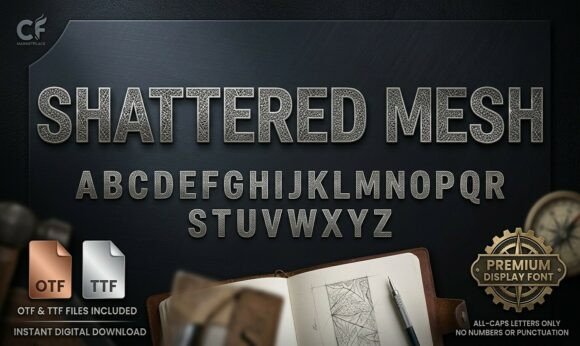
In the realm of graphic design, typography often serves as the primary vehicle for tone. While serif fonts convey tradition and sans-serifs suggest modernity, display typefaces like Shattered Mesh occupy a more specialized niche. This premium all-caps font is engineered for contexts requiring immediate visual weight and structural intensity. It is not merely a tool for legibility; it is an instrument of atmosphere, designed to evoke feelings of durability, conflict, and technological advancement.
For designers working on fantasy RPGs, industrial sci-fi projects, or action-oriented media, selecting the right typeface involves balancing aesthetic appeal with functional readability. Shattered Mesh offers a distinct solution through its beveled edges and inner textures, creating a three-dimensional, metallic quality that stands out against dark, atmospheric backgrounds. However, understanding when to deploy this specific style requires a nuanced evaluation of its strengths, limitations, and comparative advantages over other heavy-duty typographic options.
The Aesthetic Architecture of Shattered Mesh
The core identity of Shattered Mesh lies in its construction. Unlike flat, two-dimensional fonts that rely solely on stroke weight for impact, this typeface incorporates intrinsic depth. The distinctive beveled edges simulate light reflection, giving the letters a chiseled, armored appearance. This design choice is intentional, aiming to replicate the look of forged metal or reinforced concrete. The "shattered" aspect refers to the subtle irregularities and textural details within the letterforms, which prevent the font from appearing too sterile or digital.
This level of detail makes Shattered Mesh particularly effective for heroic titles and heavy-duty wordmarks. In these applications, the text is not just information; it is a graphical element that contributes to the overall composition. The font’s all-caps structure ensures uniform height and presence, eliminating the visual hierarchy issues that can arise with mixed-case sentences in large-scale headers. By commanding attention through sheer physical presence, it allows designers to create layouts that feel grounded and substantial.
Comparing Textured Display Fonts to Standard Alternatives
When evaluating Shattered Mesh, it is helpful to compare it against broader categories of display typography. Standard bold sans-serifs, such as those commonly used in corporate branding, prioritize clarity and neutrality. They are versatile but often lack the emotional resonance required for cinematic or gaming contexts. On the other hand, highly decorative script or handwritten fonts offer personality but frequently sacrifice readability and gravitas.
Shattered Mesh sits between these extremes. It offers the readability of a geometric sans-serif but adds the emotional weight of a textured illustration. Compared to other "grunge" or "distressed" fonts, which often rely on random noise overlays to simulate wear and tear, Shattered Mesh maintains a structured integrity. The distress is controlled and architectural rather than chaotic. This distinction is crucial for professional branding, where a sense of order and precision is still required despite the gritty aesthetic.
Another common alternative is the use of standard 3D effects applied to flat fonts via software like Photoshop or Illustrator. While this approach offers flexibility, it can often look artificial or inconsistent across different media. Shattered Mesh, being designed with these qualities baked into the glyph shapes, ensures a consistent metallic quality that scales better and renders more reliably across various digital and print formats. This reduces the post-production workload for designers who need a polished look without extensive manual editing.
Strategic Use Cases and Best-Fit Scenarios
Identifying the right environment for Shattered Mesh is key to leveraging its potential. Its design language speaks directly to themes of strength, resilience, and high-stakes action. Consequently, it excels in industries and genres where these values are central to the brand identity.
- Fantasy and Sci-Fi Gaming: In role-playing games (RPGs), title screens and chapter headers need to convey the scale of the world. Shattered Mesh’s armored presence fits seamlessly into interfaces depicting futuristic machinery or ancient, fortified structures.
- Cinematic Posters and Trailers: Action movies and thrillers benefit from typography that suggests momentum and danger. The font’s ability to stand out on dark, moody backgrounds makes it ideal for poster credits and promotional materials where contrast is essential.
- Industrial and Architectural Branding: For companies involved in construction, manufacturing, or heavy engineering, the font’s structural aesthetic can reinforce messages of reliability and durability. It moves beyond generic corporate fonts to create a brand identity that feels physically robust.
- Event Promotion: High-octane events, such as motorsports competitions or extreme sports tournaments, require visuals that match the energy of the activity. Shattered Mesh provides the visual volume necessary to capture attention in crowded marketing spaces.
In each of these scenarios, the font acts as a visual anchor. It does not merely label the content; it contextualizes it. When a viewer sees Shattered Mesh, they immediately anticipate a experience that is intense, serious, and professionally crafted. This pre-conditioning of the audience is a powerful tool in marketing and user experience design.
Limitations and Tradeoffs to Consider
Despite its strengths, Shattered Mesh is not a universal solution. Its specialized nature means it comes with specific tradeoffs that designers must acknowledge. The most significant limitation is its readability in smaller sizes or longer bodies of text. The intricate beveling and texture that make it striking at large scales can become visual noise when reduced. Therefore, it should strictly be reserved for headlines, logos, and short phrases.
Furthermore, the font’s strong personality can overwhelm delicate or minimalist design systems. If a project relies on subtle elegance, soft pastels, or organic shapes, Shattered Mesh may clash with the overall aesthetic. Its industrial hardness requires a complementary visual environment—typically one featuring high contrast, dark tones, and sharp geometric elements. Using it in a light, airy layout may result in a disjointed user experience where the typography feels aggressive rather than integrated.
Another consideration is accessibility. While the all-caps format is impactful, it can be slightly harder to read for individuals with certain cognitive disabilities compared to mixed-case text. Designers should ensure that critical information is not conveyed solely through this font and that sufficient contrast ratios are maintained, especially when placing the metallic-textured letters against complex backgrounds.
Making an Informed Decision
Choosing Shattered Mesh ultimately depends on the narrative you wish to tell. If your project demands a sense of permanence, power, and cinematic drama, this font offers a ready-made solution that avoids the clichés of standard bold types. It provides a professional, armored presence that is built to last, aligning well with brands that want to project confidence and strength.
However, if your design goals prioritize approachability, warmth, or minimalism, other typographic choices may serve you better. The decision should be guided by the emotional response you want to elicit from your audience. For those leaning into a gritty post-apocalyptic aesthetic or a high-end architectural identity, Shattered Mesh delivers a cohesive and compelling visual statement. By understanding its specific capabilities and constraints, designers can use it not just as a font, but as a strategic asset in their visual communication toolkit.
Ultimately, the value of Shattered Mesh lies in its ability to forge a path of visual strength. It transforms simple words into monumental structures, inviting the viewer to engage with the content on a deeper, more visceral level. When used with intention and restraint, it elevates design from functional to formidable.