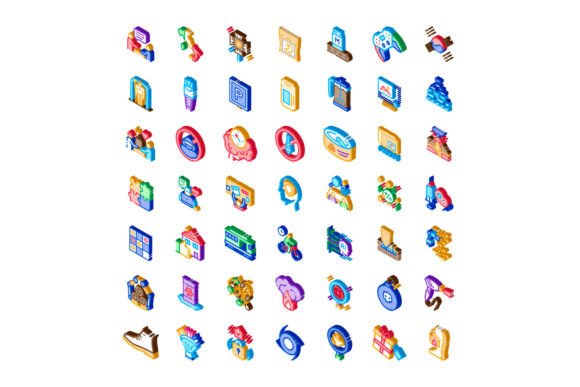
Digital Isometric Signs Collection Illus: Elevating Visual Communication in Modern Design
In the rapidly evolving landscape of digital design, clarity and engagement are paramount. As businesses and creators strive to capture attention in crowded online spaces, the visual language we use must be both intuitive and aesthetically compelling. This is where the Digital Isometric Signs Collection Illus becomes an invaluable resource. By offering a detailed collection of isometric 3D icons representing various digital, business, medical, and everyday objects, this asset library bridges the gap between abstract concepts and tangible understanding. It illustrates a wide range of functions in a modern design style that resonates with contemporary user expectations.
The shift toward three-dimensional, isometric visuals is not merely a stylistic trend; it reflects a deeper change in how users process information. Flat design, while clean, often lacks the depth required to convey complex relationships or hierarchical structures. Isometric illustrations, with their consistent angles and lack of perspective distortion, provide a structured yet dynamic way to present data, workflows, and ideas. For professionals ranging from marketers to educators, leveraging these tools can significantly enhance the effectiveness of their communication strategies.
The Evolution of Visual Assets in Digital Workflows
Historically, iconography was limited by technical constraints. Early web design relied on simple, pixelated graphics due to bandwidth limitations and low-resolution screens. As technology advanced, flat design emerged as a response to the need for faster loading times and cleaner interfaces. However, as display technologies improved and user familiarity with digital interfaces grew, the demand for richer, more engaging visuals increased. The Digital Isometric Signs Collection Illus represents the next step in this evolution, combining the scalability of vector graphics with the depth and realism of 3D modeling.
This evolution aligns with broader changes in modern workflows. Today’s creators are expected to produce content at a pace that was unimaginable a decade ago. Freelancers, business owners, and marketing teams often operate with lean resources, requiring assets that are versatile and ready to deploy. A comprehensive collection of isometric icons allows these professionals to maintain high visual standards without the time and cost associated with custom 3D rendering for every project. The ability to mix and match elements from a cohesive library ensures brand consistency while enabling rapid iteration.
Moreover, the rise of remote work and digital collaboration has heightened the importance of clear visual communication. When teams are distributed across different time zones and cultures, text-based instructions can sometimes lead to misunderstandings. Visual aids, particularly those that use universal symbols and clear spatial relationships, help bridge these gaps. Isometric icons, with their logical structure and recognizable forms, serve as a universal language that transcends linguistic barriers.
Versatility Across Industries and Use Cases
One of the standout features of the Digital Isometric Signs Collection Illus is its breadth. The inclusion of icons representing digital, business, medical, and everyday objects means that the collection is not limited to a single niche. This versatility makes it suitable for a wide array of applications, from corporate presentations to educational materials.
- Business and Finance: In the corporate world, abstract concepts like growth, strategy, and analytics can be difficult to visualize. Isometric icons of charts, briefcases, and interconnected nodes provide a concrete representation of these ideas, making presentations more engaging and easier to understand.
- Healthcare and Medicine: The medical sector benefits greatly from clear, non-threatening visuals. Isometric representations of medical equipment, health symbols, and care-related objects can help simplify complex health information for patients, making it more accessible and less intimidating.
- Technology and Digital Services: For tech companies, illustrating software architecture, cloud computing, or cybersecurity measures often requires abstract visualization. Isometric servers, locks, and network diagrams offer a modern, professional look that aligns with the innovative nature of the industry.
- Education and E-Learning: Educators and course creators can use these icons to break down complicated subjects into digestible visual chunks. Whether explaining historical timelines, scientific processes, or literary structures, isometric signs add a layer of engagement that keeps learners interested.
The relevance of such a collection extends beyond static images. In the era of interactive media, these assets can be animated to create dynamic explainer videos, interactive infographics, and engaging social media content. The modular nature of isometric design allows for easy customization, enabling creators to adjust colors, sizes, and compositions to fit specific brand guidelines or campaign themes.
Enhancing User Experience and Engagement
User experience (UX) design is fundamentally about reducing friction and enhancing satisfaction. Visual cues play a critical role in guiding users through digital interfaces. The Digital Isometric Signs Collection Illus contributes to this by providing clear, recognizable signifiers that help users navigate complex systems. When users can quickly identify the function of a button or the meaning of a section header through intuitive icons, their overall experience improves.
Furthermore, aesthetic appeal influences perceived usability. Studies have shown that users tend to perceive visually attractive interfaces as more usable, even if their actual functionality is identical to less attractive counterparts. The modern, polished look of isometric 3D icons adds a layer of professionalism and credibility to any digital product. For entrepreneurs and business owners, this can translate into higher conversion rates and increased customer trust.
Consider the impact of these visuals on landing pages. A well-designed hero section featuring relevant isometric illustrations can immediately communicate the value proposition of a product or service. Instead of relying solely on text, which requires cognitive effort to process, visuals offer instant recognition. This is particularly important in mobile-first environments, where screen real estate is limited and attention spans are short.
Practical Recommendations for Creators and Professionals
To maximize the potential of the Digital Isometric Signs Collection Illus, creators should adopt a strategic approach to integration. Here are some practical recommendations:
- Maintain Consistency: While the collection offers a wide variety of objects, it is crucial to maintain a consistent style throughout your project. Avoid mixing isometric icons with flat or hand-drawn elements unless done with deliberate artistic intent. Consistency reinforces brand identity and reduces cognitive load for the viewer.
- Use Color Strategically: Isometric designs often rely on shading and lighting to create depth. Use color to highlight key elements or guide the viewer’s eye. For instance, using a brand’s primary color for the most important icon in a sequence can draw attention to the core message.
- Balance Detail and Clarity: While 3D icons can be highly detailed, avoid overcrowding your designs. Ensure that there is enough white space around each icon to let it breathe. Overly complex compositions can overwhelm the viewer and defeat the purpose of using visual aids.
- Adapt for Accessibility: Always include alt text for images to ensure that your content is accessible to users with visual impairments. Describe the function or meaning of the icon rather than just its appearance. For example, instead of "isometric image of a server," use "icon representing cloud storage services."
- Leverage Animation: If your platform supports it, consider adding subtle animations to your isometric icons. A gentle hover effect or a sequential entrance animation can add a layer of interactivity that enhances engagement without distracting from the content.
For freelancers and agencies, building a library of pre-approved isometric assets can streamline the client approval process. By presenting mockups that utilize high-quality, professional icons, you demonstrate attention to detail and a commitment to quality. This can help differentiate your services in a competitive market.
Future-Proofing Your Visual Strategy
As we look toward the future of digital design, the importance of versatile, high-quality visual assets will only grow. The convergence of augmented reality (AR), virtual reality (VR), and traditional web design suggests a future where 3D elements are ubiquitous. By adopting isometric design principles now, creators and businesses are positioning themselves to adapt seamlessly to these emerging technologies. The skills and assets developed today will remain relevant as interfaces become more immersive and spatial.
The Digital Isometric Signs Collection Illus is more than just a set of graphics; it is a tool for better communication. In a world where information overload is a constant challenge, the ability to convey complex ideas clearly and attractively is a significant competitive advantage. Whether you are a marketer looking to boost engagement, an educator aiming to simplify learning, or a business owner seeking to enhance your brand’s professional image, integrating these modern design elements can yield substantial benefits.
Ultimately, the goal of design is to serve the user. By choosing assets that are both functional and aesthetically pleasing, you show respect for your audience’s time and intelligence. The Digital Isometric Signs Collection Illus offers a pathway to achieving this balance, providing the tools needed to create meaningful, impactful visual experiences in an increasingly digital world.